
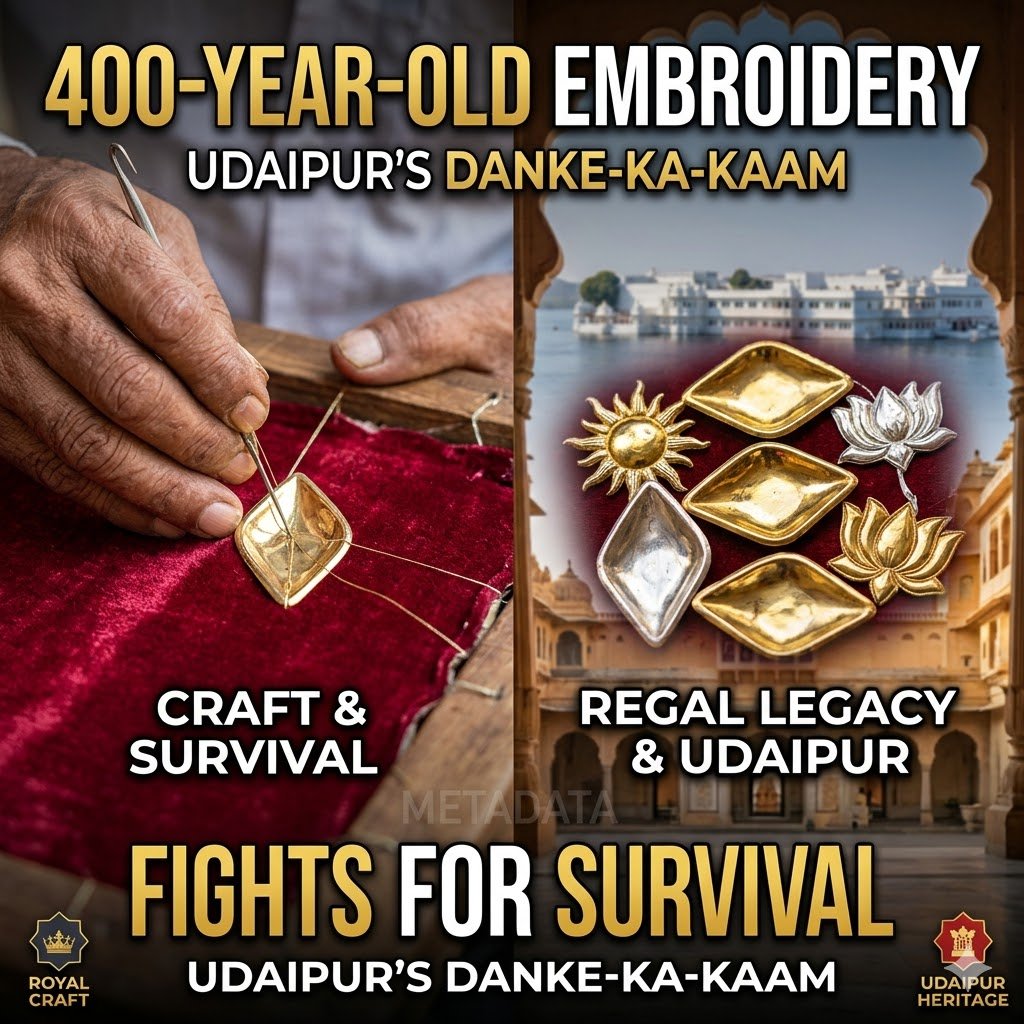
In the regal city of Udaipur, where majestic palaces reflect in shimmering lakes, a craft as ornate as the city itself is quietly fighting against time. Danke-ka-Kaam (Danka embroidery), an opulent 400-year-old metal embroidery technique that once adorned the garments of Rajput royalty, is now a languishing craft with only a handful of authentic practitioners remaining.
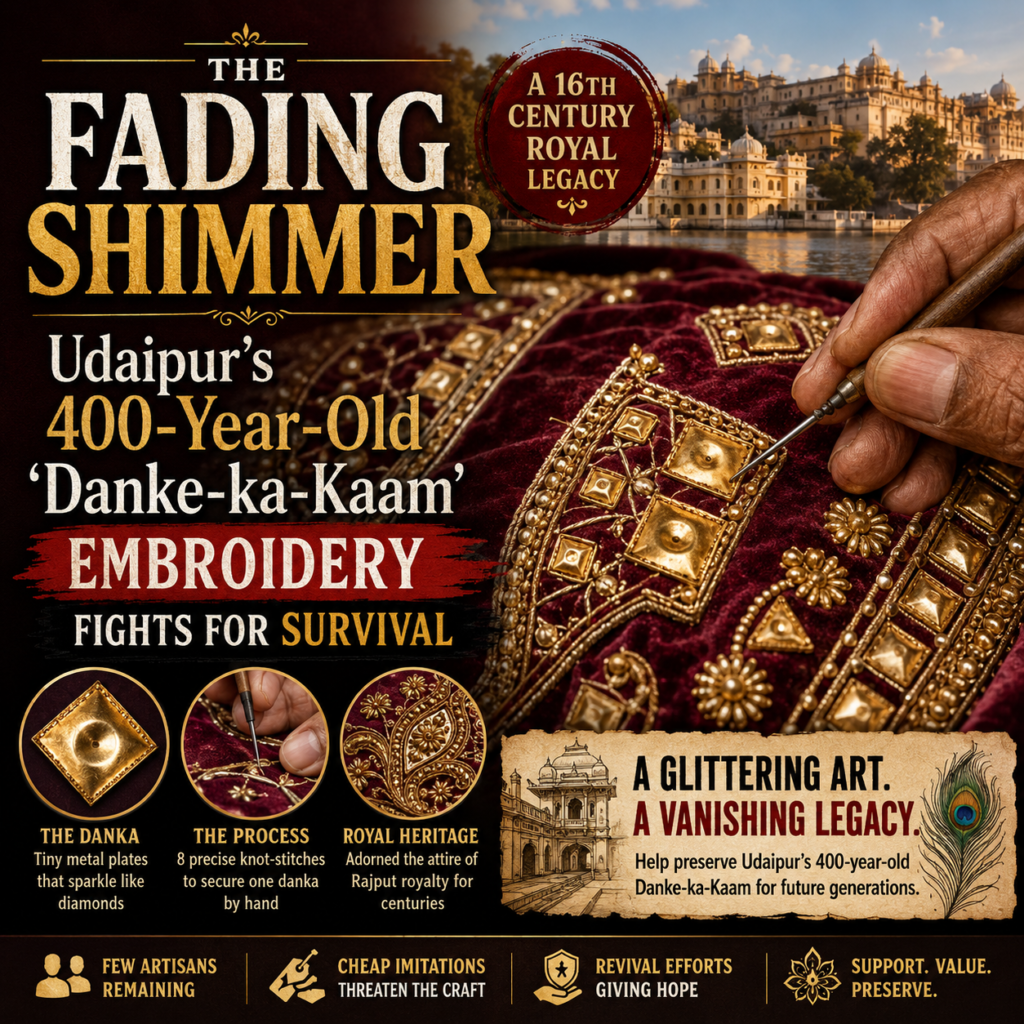
As the textile and fashion industry moves toward fast fashion and cheaper alternatives, historians and designers are racing to revive this glittering 16th-century heritage before it is lost forever.
What is Danke-ka-Kaam? The Anatomy of a Masterpiece
Danke-ka-Kaam translates to “work of the danka.” Unlike standard thread embroidery, this is a highly specialized form of metal surface ornamentation.
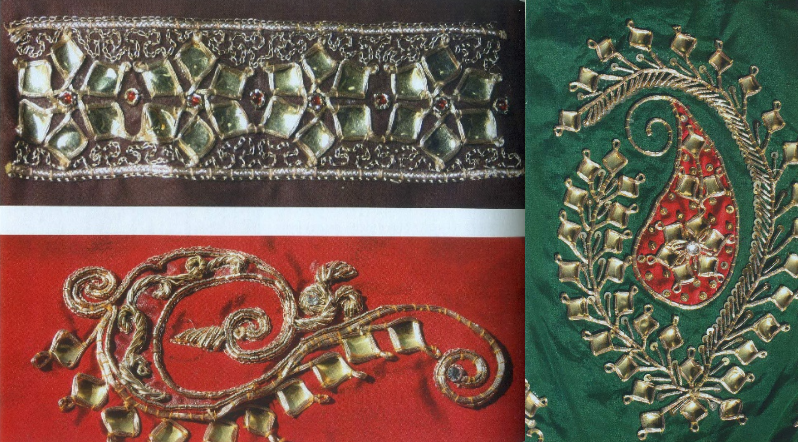
The core element of the craft is the Danka—a tiny, square or diamond-shaped metallic plate, usually no larger than 1.5 centimeters. These thin metal sheets are meticulously hand-beaten with a special stone to form a concave depression. This unique shape allows the danka to catch and reflect light, mimicking the brilliant facet of a real diamond.
The Intricate Process:
- The Metal: Originally made of pure gold, artisans later shifted to using 98% pure silver sheets electroplated with gold to make it slightly more affordable.
- The Setup: The chosen fabric (traditionally rich velvet, silk-satin, or chiffon) is stretched tightly over a large wooden frame known as an adda or khat.
- The Stitching: Using an aari (a specialized hooked needle), the artisan pierces the fabric and secures each tiny danka using kasab (fine metallic thread). It takes exactly eight meticulous knot-stitches to secure a single danka—two at the back, two at each corner, and two in the front.
The embroidery is often supplemented with zardozi, sitara (sequins), and dabka (spring wire) to create deeply embossed, three-dimensional masterpieces.
A Royal 16th-Century Legacy
The origins of Danke-ka-Kaam date back to the 16th century in the Mewar region. Historical records suggest the craft was introduced to Rajasthan by the Bohra Muslim community, who migrated from Sindh (present-day Pakistan).
The art form received heavy patronage from Maharana Pratap and subsequent Rajput rulers. It became a mandatory embellishment for royal ceremonial wear. For centuries, no royal wedding was complete without the bride wearing a Rajputi Poshak (traditional royal attire featuring a ghagra, kanchali, and odhni) encrusted with exquisite Danka work. The motifs were heavily inspired by nature, frequently featuring the sun, the moon, stylized paisleys, lotuses, and peacocks.
A Craft on the Brink of Extinction
Despite its glorious past, Danka embroidery is currently facing an existential crisis. The decline is driven by multiple factors:
- A Dwindling Artisan Pool: The craft has remained tightly guarded within the Bohra community. Today, there are only a fraction of recorded practitioners left. Master artisans like Saif-u-ddin (who does the embroidery) and Kutubuddin/Motilal Bohra (among the last remaining artisans who know the authentic technique of hand-beating the metal Danka plates) are the last torchbearers of the pure craft.
- Cheap Imitations: The influx of mass-produced, cheap brass and plastic alternative pieces has destroyed the market for authentic, silver-based Danka work.
- Loss of Patronage: The steep cost of the heavy metal embroidery and changing consumer tastes have shifted demand away from the craft.
Revival and the Road Ahead
Fortunately, recent years have seen a desperate push to save the art form. The National Design Centre has included Danka Embroidery in its Comprehensive Skill Upgradation Programs (CSUP) for languishing crafts.
Simultaneously, contemporary fashion designers and researchers are attempting to bridge the gap between ancient royalty and modern aesthetics. By introducing Persian motifs and incorporating Danka work into lighter, Indo-Western garments and accessories (like potlis and bangle boxes), there is a renewed effort to make the craft relevant and affordable for the modern global consumer.
Whether Danke-ka-Kaam experiences a vibrant renaissance or fades into the history books ultimately depends on modern consumers recognizing—and investing in—the true value of this 400-year-old royal art.