
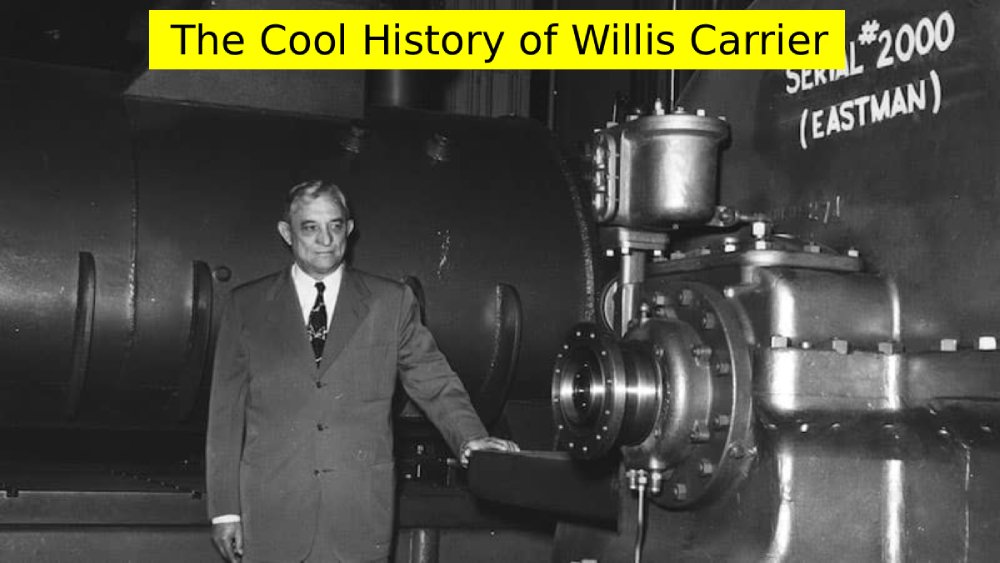
It is hard to imagine surviving a scorching summer without the sweet, cooling relief of an air conditioner. Today, AC units are a standard fixture in homes, offices, hospitals, and cars worldwide. But who do we have to thank for this revolutionary technology?
The answer is Willis Haviland Carrier, a brilliant 25-year-old engineer who invented the first modern electrical air conditioning unit in 1902.
However, the origin of the AC has a fascinating twist: it was not actually invented to keep people cool! Here is the full history behind the invention that changed the way we live and work.
🏭 The Printing Press Problem (1902)
In the summer of 1902, the Sackett & Wilhelms Lithography and Publishing Company in Brooklyn, New York, was facing a major crisis. Intense heat and fluctuating humidity in their printing plant were wreaking havoc on their operations. The moisture in the air was causing their magazine pages to swell and wrinkle, which meant the colored inks were not aligning properly, resulting in blurry, ruined prints.
The company reached out to the Buffalo Forge Company for a solution, and the task was assigned to a young engineer named Willis Carrier.
On July 17, 1902, Carrier finalized his design. He created a system that blew air over coils filled with cold water. As the air cooled, the excess humidity condensed on the coils, effectively stripping the moisture out of the air.
- The Result: It successfully stabilized the humidity for the paper, but it had a massive side effect—it made the room incredibly cool and comfortable for the workers. The modern air conditioner was born.
❄️ The Predecessors: Who Tried Before Carrier?
While Willis Carrier holds the title for the modern electrical air conditioner, he was not the first person to try artificial cooling.
In the 1840s, a Florida physician named Dr. John Gorrie was desperately trying to cool down hospital rooms for patients suffering from yellow fever and malaria. Gorrie believed that “bad air” caused the diseases, so he invented a machine that used a compressor powered by a steam engine to create ice, which then blew cool air across the wards. He received a patent for his ice machine in 1851, but his financial backers died, and his invention never reached the mass market.
🗣️ Who Coined the Term “Air Conditioning”?
Willis Carrier invented the machine, but he called it the “Apparatus for Treating Air.” So, where did the name come from?
In 1906, a textile mill engineer in North Carolina named Stuart W. Cramer was looking for ways to add moisture to the air in his factory to make the yarn easier to spin. He filed a patent for his technique and called it “air conditioning.” The term caught on quickly, and even Willis Carrier adopted it, eventually naming his own business the Carrier Air Conditioning Company of America.
🍿 Moving from Factories to Movie Theaters
For its first two decades, air conditioning was strictly industrial, used in textile mills, pharmaceutical plants, and printing presses.
It wasn’t until the 1920s that the general public got to experience it. In 1922, Carrier invented the Centrifugal Refrigeration Compressor, making the units smaller, safer, and more powerful. In 1925, Carrier installed this system in the Rivoli Theater in Times Square, New York.
Before this, movie theaters were notoriously hot, sweaty, and completely avoided by the public during summer. With the invention of the AC, people flocked to the theaters just to escape the heat, giving birth to the phenomenon of the “Summer Blockbuster.”
By the 1950s, smaller, more affordable window units finally made their way into private homes, permanently changing human comfort levels.