
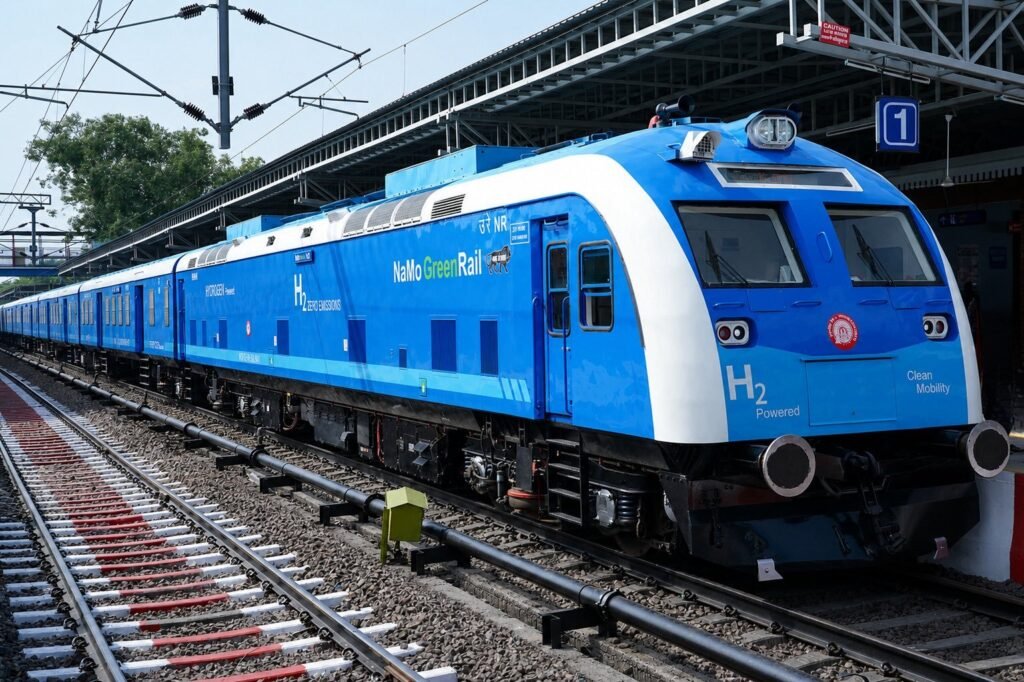
A new era of sustainable mass transit has officially begun. Indian Railways has written a golden chapter in its history with the grand unveiling of the nation’s first-ever, completely indigenous hydrogen-powered train.
Flagged off from the Jind railway station by Prime Minister Narendra Modi, the train has officially commenced its historic operations on the 89-kilometer corridor connecting Jind and Sonipat in Haryana.
This major milestone places India at the absolute forefront of the global transition toward “Green Mobility” and zero-carbon emission mass transport.
The Science Behind the Green Locomotive
At the heart of this technological marvel lies the advanced Hydrogen Fuel Cell system.
Unlike traditional electric trains that depend on massive infrastructure like continuous overhead catenary wires, or conventional diesel engines that burn heavy fossil fuels, this train generates its own clean electricity onboard. The fuel cells create power by mixing compressed hydrogen with oxygen drawn from the surrounding air.
The only byproduct of this chemical reaction? Pure, clean water vapor.
By replacing diesel with hydrogen, the train ensures absolute zero carbon emissions, eliminates harmful particulate matter from the air, and runs with drastically reduced operational noise, offering a whisper-quiet journey for passengers.
Smashing Global Records: “Make in India” Takes the Lead
While a handful of technologically advanced nations like Germany, China, Japan, and the United States have already deployed hydrogen rail systems, India’s debut has completely rewritten the global standards for scale and power under the ‘Make in India’ initiative.
- World’s Longest and Highest Passenger Capacity: Most operational hydrogen trains globally are limited to short 2 or 3-coach configurations. India’s indigenous train features a massive 10-coach layout, capable of carrying an astonishing 2,600 passengers per trip, with 682 dedicated seats.
- Unrivaled Power: Boasting a staggering 3,200 horsepower (HP) propulsion system, it stands as the most powerful hydrogen-powered passenger trainset in the world today.
Operational Blueprint and Safety Infrastructure
The train is slated to become a daily staple for commuters in Haryana, covering a total distance of 356 kilometers every day through two complete round-trips. The 89-km one-way journey takes approximately two hours, providing crucial green connectivity across 12 intermediate stations.
While the train proved during rigorous track trials that it can comfortably clock speeds up to 110–120 kmph, it will run at a steady, optimized operational speed of 75 kmph during its initial regular commercial runs.
To support this cutting-edge fleet, Indian Railways has set up a specialized, state-of-the-art Hydrogen Refuelling Station (HRS) at the Jind junction. Because hydrogen is highly volatile, the trainsets are engineered with an advanced, multi-layered safety framework. The system features continuous automated cabin ventilation and intelligent sensors that instantly cut off the hydrogen supply at the slightest detection of heat, smoke, flames, or gas leaks.
As the Indian government pushes heavily toward its goal of achieving net-zero carbon emissions, this triumphant launch marks a monumental leap from experimental technology to real-world, heavy-duty sustainable transport.
Tags
ndia hydrogen train launch, Indian Railways green mobility, hydrogen fuel cell train Jind Sonipat, Make in India hydrogen train, zero emission trains, most powerful hydrogen train.