
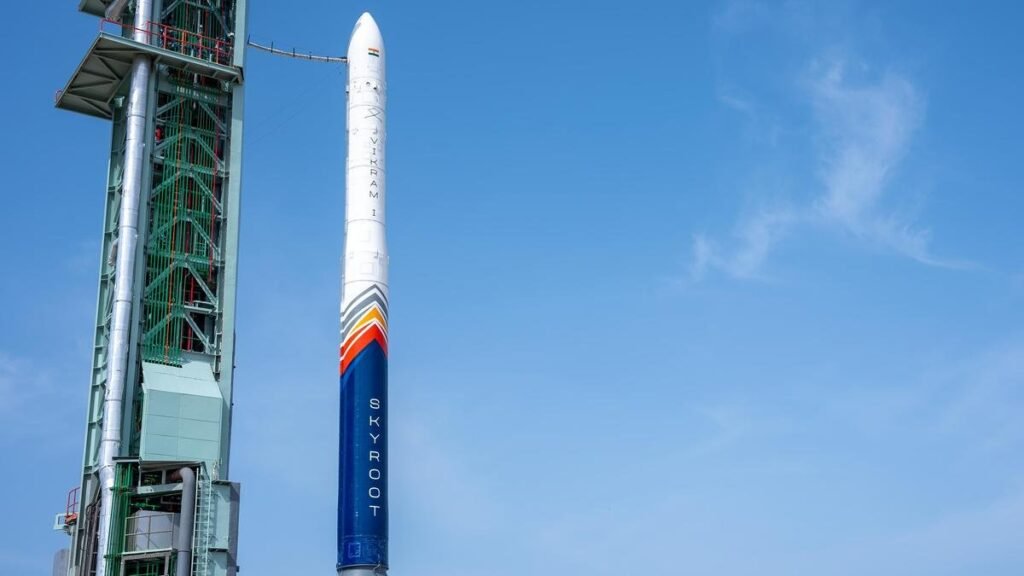
A new era in the global space race has officially dawned from the shores of India. Prime Minister Narendra Modi has extended his warmest congratulations to the team at Hyderabad-based space tech startup Skyroot Aerospace following the spectacular and flawless maiden launch of their orbital rocket, Vikram-1.
Hailing the achievement as a monumental milestone, PM Modi characterized the launch as a defining moment for Indian space research and a massive triumph for the country’s private space sector.
In a personal interaction with Skyroot Aerospace’s leadership, the Prime Minister praised the young engineers and scientists for showcasing the true power of a self-reliant India (Atmanirbhar Bharat). He noted that this breakthrough will inspire a whole new generation of Indian youths to innovate, disrupt, and dream without boundaries.
Mission Aagaman: Redefining Private Space Exploration
The historic liftoff took place from the Satish Dhawan Space Centre (SDSC) in Sriharikota, Andhra Pradesh. Codenamed “Mission Aagaman” (meaning Arrival), the flight successfully injected its payloads into orbit, making India one of only a handful of nations—alongside the US and China—to possess a private sector capable of end-to-end orbital space deployment.
Technical Specifications of Vikram-1:
- Structure: A 24-meter-tall, multi-stage launch vehicle built entirely using advanced, lightweight carbon-composite materials.
- Propulsion: The rocket features a highly sophisticated four-stage configuration. The first three stages utilize state-of-the-art 3D-printed solid-fuel rocket motors, while the final stage employs a liquid-propellant orbital adjustment module for precise payload deployment.
- Capacity: Specifically engineered to reliably place payloads weighing up to 350 kg into a 450-km Low Earth Orbit (LEO).
During the mission, the massive Kalam-1200 solid motor executed perfectly, propelling the vehicle through maximum aerodynamic pressure. Just 17 minutes after clearing the launchpad, the rocket successfully deployed all its onboard equipment exactly into their targeted slots, making the orbital debut an absolute textbook success.
Unique Payloads: From Technology to Art in Space
“Mission Aagaman” carried an eclectic and highly unique array of technology demonstrators, commercial satellites, and symbolic items into space:
- The Prime Minister’s Postcard: A handwritten postcard from PM Modi himself, carrying the message “Vande Mataram”, accompanied by thousands of digital postcards from space enthusiasts worldwide.
- Commercial Innovations: The flight successfully hosted six distinct payloads. Notably, this included a specialized robotic arm called ‘Embrace’ by Cosmoserve, and a cutting-edge on-orbit release mechanism designed by German space firm DCUBED.
- Cosmic Art: The cargo also featured highly specialized micro-art pieces, including an intricate 18-karat gold miniature rocket and a uniquely engineered lab-grown diamond named ‘Cosmic Bloom’ by Cosmos Diamonds.
The Beginning of a Commercial Space Superpower
Founded in 2018 by former ISRO scientists Pawan Kumar Chandana and Naga Bharath Daka, Skyroot Aerospace has steadily disrupted the iGaming-speed growth of the global space-tech ecosystem. Having already launched India’s first privately built suborbital rocket (Vikram-S) back in 2022, Skyroot has now cemented its status as India’s premier space-tech unicorn.
This historic orbital success validates the bold space sector reforms introduced by the Indian government in 2020. It proves that private players are no longer just vendors supplying parts, but fully capable space faring entities ready to capture a massive share of the booming global small-satellite launch market.
Keywords
Skyroot Aerospace, Vikram-1 launch, Mission Aagaman, private rocket India, PM Modi space startup, Indian space tech unicorn, Sriharikota launch, small satellite launch market.