
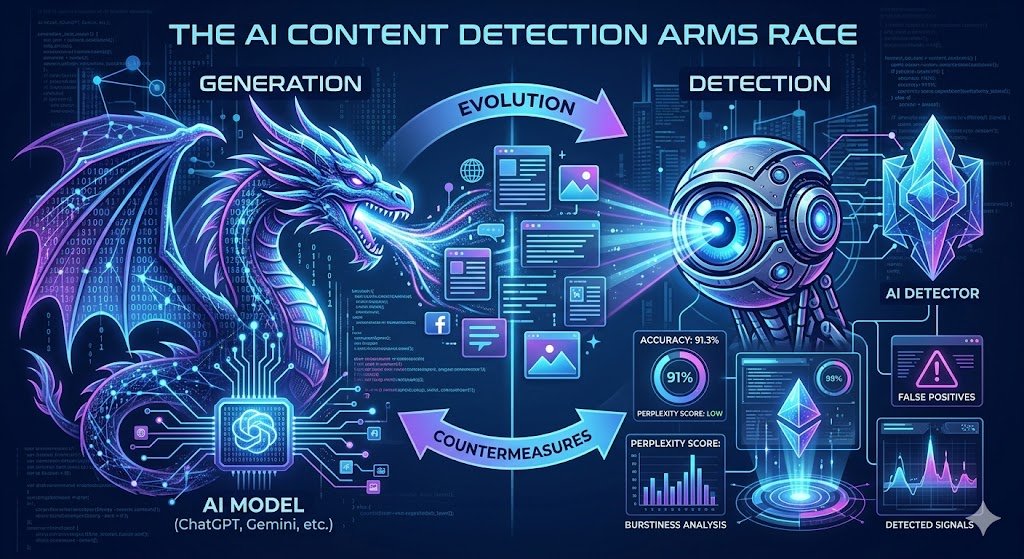
As generative AI models become increasingly sophisticated, the “cat and mouse” game between content generation and detection has officially evolved into a full-scale arms race. With major tech giants rolling out massive infrastructure changes and specialized detectors fighting to maintain accuracy, the landscape of AI content verification looks drastically different today than it did just a few years ago.
Google’s Push for Verifiable Authenticity
Rather than relying purely on probabilistic text analysis, the tech industry is pivoting hard toward embedded provenance. In a major May 2026 update, Google expanded its content transparency tools across Search, Gemini, Chrome, Pixel, and Cloud.
This expansion relies on two main pillars:
- SynthID Watermarking: Google’s digital watermarking system, SynthID, has now embedded imperceptible signals into over 100 billion images and videos, as well as 60,000 years of audio. Companies like OpenAI, Kakao, and ElevenLabs are also integrating this technology into their content generation pipelines.
- C2PA Content Credentials: Google is heavily utilizing this industry standard, which records exactly how media was created and modified. The Pixel 10 was the first smartphone to provide native support for these credentials for images, with video support rolling out to Pixel 8, 9, and 10 devices. By adding provenance data at the point of capture, it becomes much easier to distinguish original camera content from files that were later generated or edited with AI.
To support enterprises, Google also launched a new AI Content Detection API on Google Cloud’s Gemini Enterprise Agent Platform, giving businesses a robust way to spot AI content from both Google and other popular models.
The Top Third-Party Detectors of 2026
While embedded metadata is the future, statistical text analysis remains crucial for analyzing unwatermarked text. The 2026 detector market is dominated by tools trying to balance high accuracy with low false-positive rates:
- Sapling & Winston AI: In recent 2026 benchmarks, Sapling has been noted for its high accuracy and regular updates to support emerging models like DeepSeek. Winston AI frequently scores top marks for professional reports and institutions, offering features like OCR support (scanning handwriting and images) and prediction maps.
- Originality.ai & Red Paper: Originality.ai remains a top choice for SEO agencies and content teams, offering bulk scanning and readability analysis. Meanwhile, Red Paper combines AI detection with a plagiarism checker against 91+ billion sources, and also detects AI-generated images from models like DALL-E and Midjourney.
- Turnitin: In academia, Turnitin remains the institutional standard. In 2026, the platform continues to favor a low false-positive rate over catching every single instance of AI, acknowledging the serious consequences of false cheating accusations in a school environment.
The Ongoing Battle with False Positives
Despite significant maturity in machine learning models, the Achilles’ heel of AI detection in 2026 remains the “false positive”—where human-written text is mistakenly identified as machine-generated.
Because text detectors analyze statistical metrics like perplexity (predictability) and burstiness (variation in sentence structure), they often struggle with specific types of human writing. Evidence from 2026 indicates that students with neurodiversity or those who speak English as a Second Language (ESL) are more frequently flagged, raising serious ethical and accessibility concerns.
Furthermore, as AI models are refined to better replicate human variance, pure statistical detection is facing mounting difficulties. When tested with adversarial data—such as AI text that has been asked to conceal its origins or heavily paraphrased by a human—the precision of many detectors can drop to 60–70%.
As the lines continue to blur, the consensus among experts in 2026 is clear: no single detector is foolproof, and manual review, combined with strong metadata standards like C2PA, is mandatory for the future of digital trust.