
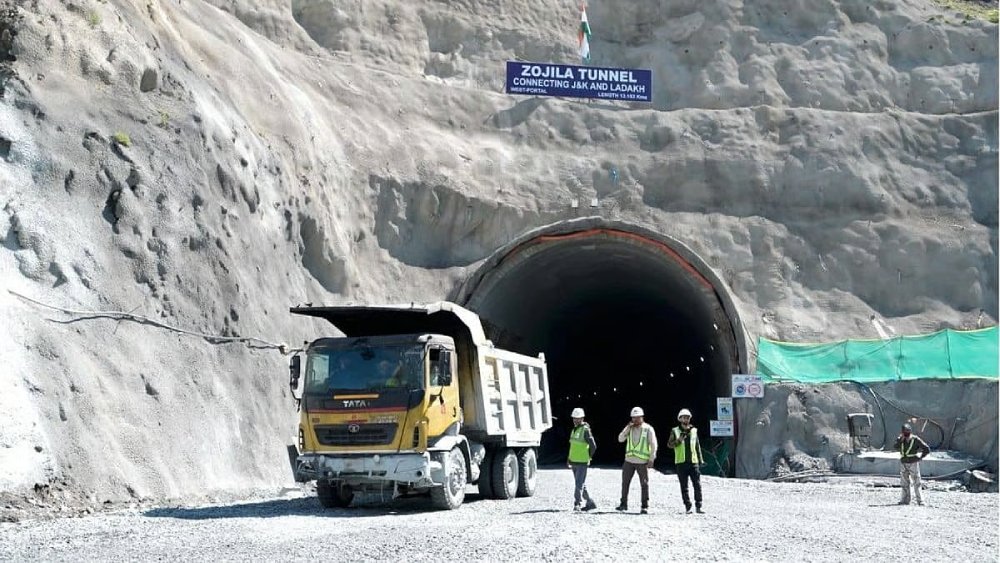
The decades-old dream of establishing all-weather connectivity between the Kashmir Valley and Ladakh has finally moved a massive step closer to reality. The Zojila Main Tunnel—a towering symbol of India’s technical proficiency, engineering prowess, and indomitable resolve—has successfully achieved its historic ‘breakthrough’ today! In tunneling terminology, a ‘breakthrough’ is the monumental moment when excavation from both ends of the mountain finally meets, creating a continuous passage. This is not just the completion of a construction phase; it is a massive victory for human determination and the vision of a ‘New India’ over the hostile and treacherous conditions of the high Himalayas.
Here is everything you need to know about Asia’s longest tunnel and why it is an absolute game-changer for India’s future.
🏔️ What is the Zojila Tunnel? (Key Facts)
The Zojila Tunnel is a massive infrastructure project located on the Srinagar-Kargil-Leh National Highway (NH-1) at a staggering altitude of 11,578 feet above sea level.
- Length: Spanning 13.15 kilometers, it is officially set to become Asia’s longest single-tube, bi-directional road tunnel.
- Construction Technology: The tunnel is being built using the world-class ‘New Austrian Tunnelling Method’ (NATM) to safely navigate the fragile and unpredictable Himalayan geology.
- Execution & Cost: Being executed under the PM Gati Shakti master plan by Megha Engineering & Infrastructures Ltd. (MEIL) and overseen by NHIDCL, the project represents an investment of over ₹6,800 crore.
- Timeline: With the breakthrough achieved six months ahead of schedule, the tunnel is officially targeted to open for the public by February 2028.
🚀 Why is this Project a ‘Game-Changer’?
1. Reducing a 3-Hour Journey to 15 Minutes
Currently, crossing the treacherous Zojila Pass takes around 3 to 4 hours, navigating steep inclines, blind curves, and lethal drops. Once the tunnel is fully operational, this exact distance can be covered safely in a mere 15 to 20 minutes.
2. True All-Weather Connectivity
Every year, the Ladakh region gets completely cut off from the rest of the country for nearly six months (November to April) due to heavy snowfall and the extreme threat of avalanches. The Zojila Tunnel, coupled with the nearby Z-Morh tunnel, will guarantee 365-day, uninterrupted, all-weather connectivity between the Kashmir Valley and Ladakh.
3. A Massive Strategic and Military Advantage
Given its proximity to the sensitive borders with China and Pakistan, this tunnel is a massive strategic asset for the Indian Armed Forces. It ensures that military convoys, troops, heavy machinery, and essential supplies can be deployed rapidly to high-altitude bases in Ladakh, even during the peak of winter.
4. Economic Boom and Tourism Revival
During the winter road closures, the people of Ladakh historically faced severe shortages of essential commodities like vegetables, medicines, and fuel, leading to skyrocketing prices. The tunnel puts an end to this isolation. Furthermore, year-round access will unlock unprecedented opportunities for the local tourism and hospitality industries, generating massive employment.
⚙️ Conquering the Ultimate Engineering Challenge
Constructing this tunnel was no ordinary feat. Over 1,400 workers and engineers endured brutal conditions—battling freezing temperatures plummeting to -30°C, fierce blizzards, low oxygen levels, and the constant threat of avalanches.
Today’s historic breakthrough ceremony, attended by Union Minister Nitin Gadkari, J&K Lieutenant Governor Manoj Sinha, and Chief Minister Omar Abdullah, proved to the world that India’s infrastructure development is rapidly surpassing global standards. When the “Highway of Progress” takes shape, the pace of nation-building cannot be stopped!