
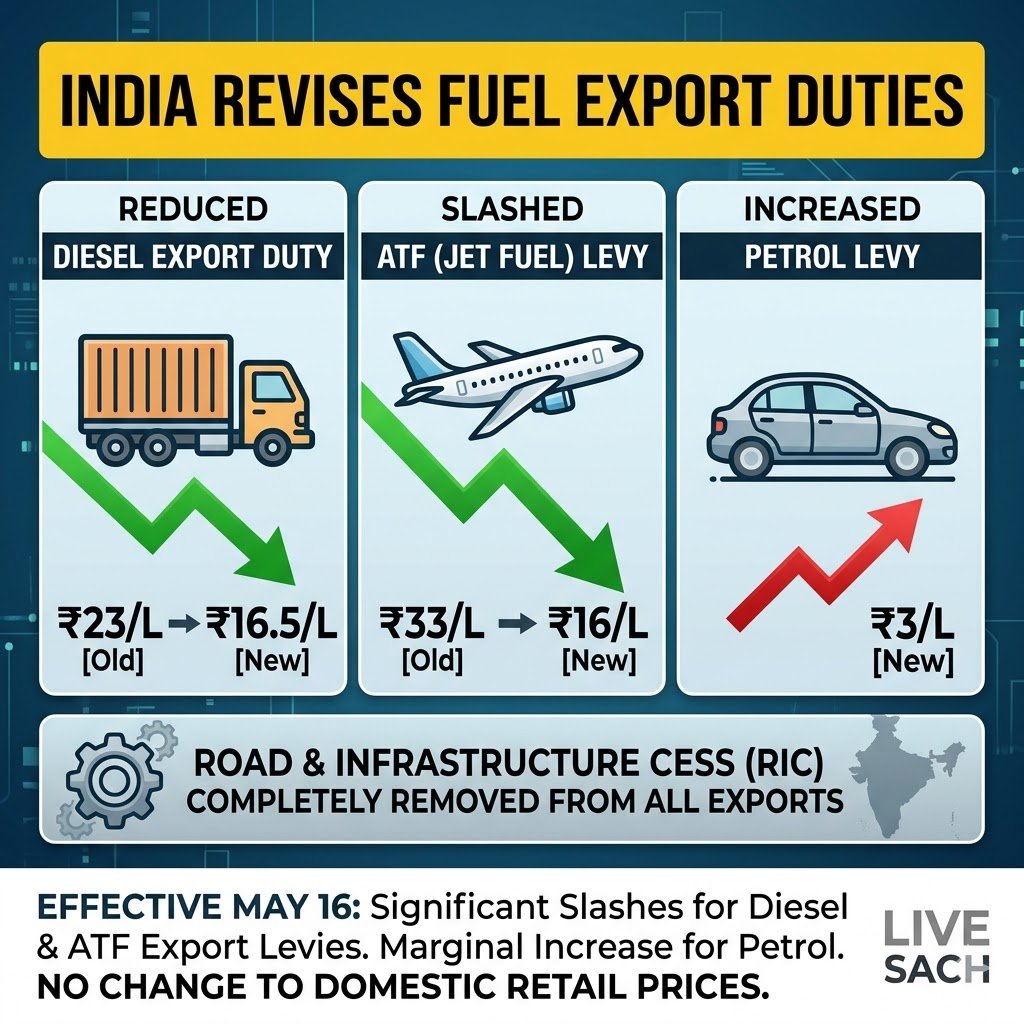
In its latest fortnightly policy intervention, the Government of India has announced a comprehensive restructuring of export duties on refined petroleum products. The revisions, introduced by the Ministry of Finance on May 15, 2026, officially came into effect today, May 16, 2026.
The new directives bring a significant financial breather for domestic oil exporters dealing in diesel and aviation fuel, though levies on petrol have seen a marginal uptick.
Detailed Breakdown of Revised Export Duties
The adjustments have been introduced through modifications to the Special Additional Excise Duty (SAED) framework, reflecting the shifting margins in global energy markets:
- Diesel: The export duty on diesel has been slashed considerably, coming down to ₹16.5 per litre, a sharp drop from the previous rate of ₹23 per litre.
- Aviation Turbine Fuel (ATF): Refiners exporting jet fuel will see a massive relief as the export levy has been cut to ₹16 per litre, down from the earlier rate of ₹33 per litre.
- Petrol: Bucking the downward trend of other fuels, the SAED on petrol exports has been marginally raised to ₹3 per litre.
Additionally, in an institutional move to ease export logistics and lower overheads, the central government has completely removed the Road and Infrastructure Cess (RIC) that was previously levied on exported shipments of petrol, diesel, and ATF.
Zero Impact on Local Domestic Retail Prices
Energy analysts note that Indian consumers will experience no direct changes at local fuel pumps following this update. The Ministry of Finance clarified that domestic excise duties on petrol and diesel remain untouched. Consequently, retail fuel prices within India will not alter as a result of these export-linked modifications.
Why India Continues to Tinker with Fuel Export Levies
India utilizes a dynamic fuel taxation architecture that reviews the duty structure of petroleum exports on a fortnightly basis. These ongoing adjustments are strictly calculated based on the rolling average of international prices for crude oil and globally traded refined products.
By scaling duties up or down every two weeks, the government protects domestic fuel security, prevents domestic oil producers from excessively diverting their product to more lucrative international markets during price spikes, and absorbs windfall gains made during shifting macroeconomic windows.